

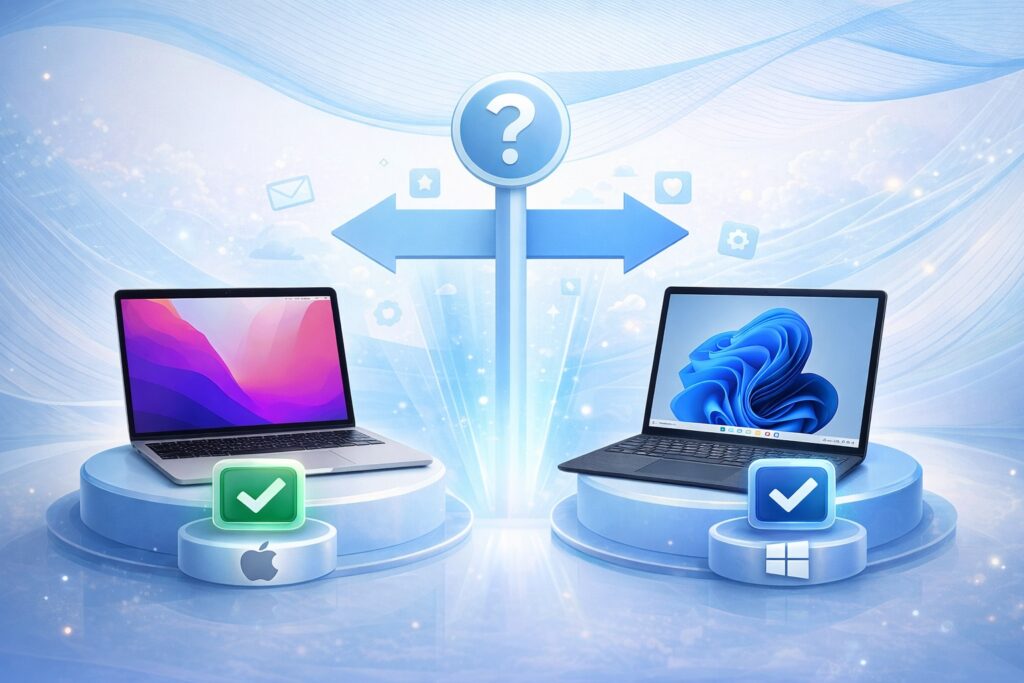
Device Choice Is Not an IT Preference — It’s an Enterprise Strategy
When organizations go through a merger, platform decisions often feel urgent. Leadership wants clarity. IT wants simplicity. Finance wants predictability.
And so the question inevitably comes up:
“Should we standardize everyone on the same device?”
On the surface, it sounds like a responsible move. In reality, forced platform decisions during periods of change often create unnecessary disruption at exactly the wrong time.
The Real Risk During Organizational Change
Mergers are already disruptive. Teams are adapting to new structures, new workflows, and new leadership dynamics. Introducing a forced device migration during this period adds friction where stability is needed most.
Retraining takes time. Lost productivity compounds quickly. And for mission-driven organizations or lean enterprises, that cost isn’t always obvious on a spreadsheet—but it’s very real operationally.
The problem isn’t Windows versus Mac.
The problem is treating device choice as an ideological decision instead of a strategic one.
Reframing the Question
In a recent engagement, Virtua worked with a national nonprofit navigating a merger between two organizations: one primarily Windows-based, the other entirely Mac-based. Both environments were effective. Both groups were productive.
Rather than asking which platform should win, we reframed the conversation:
How do we preserve productivity while unifying the organization?
That shift changed everything.
Instead of standardizing hardware, the organization focused on standardizing what actually matters at scale:
-
Identity and access
-
Collaboration tools
-
Security controls
-
Support ownership
Standardize the Layer That Matters
The organization adopted Microsoft 365 as a unified collaboration and identity layer, ensuring consistent email, calendaring, and communication across teams—regardless of device.
With that foundation in place, hardware became less of a fault line and more of a supported choice.
Macs and Windows PCs were treated as first-class endpoints. macOS was managed intentionally, secured to organizational standards, and supported operationally—not as an exception.
Support Drives Stability, Not Mandates
Importantly, device choice wasn’t incentivized or mandated.
Employees were simply supported on the platform they worked best on.
Over time, something interesting happened: platform distribution stabilized naturally. As headcount grew, both Mac and Windows usage scaled without creating additional complexity or friction.
That’s what happens when choice is paired with structure.
What Enterprise Leaders Can Take Away
For organizations facing mergers, consolidation, or rapid growth, the lesson is clear:
-
Forcing a single platform during change increases risk.
-
Standardizing identity, security, and collaboration delivers real operational consistency.
-
When macOS is supported intentionally, it scales cleanly alongside Windows.
-
Device choice, when implemented strategically, preserves momentum instead of slowing it down.
Device Choice, Done Right
Device choice isn’t about preference. It’s about outcomes.
When leaders focus on productivity, supportability, and operational clarity—rather than ideology—mixed environments stop being a liability and start becoming an advantage.
We’ve documented this approach in more detail in our white paper, Device Choice as an Enterprise Strategy, for organizations navigating exactly these challenges.
👉 If your organization is facing a merger, platform consolidation, or rapid growth in a mixed environment, now is the time to rethink how device decisions are made.